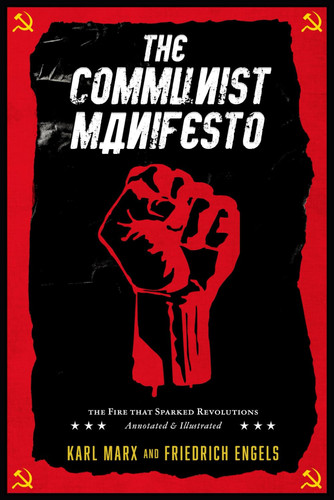
The Communist Manifesto: The Fire That Sparked Revolutions - Annotated and Illustrated
7 views
Get This Book
Prices may vary. Links may earn us a commission and open external websites.
Publisher
Independently published
ISBN
ISBN-13: 9798288976636Synopsis
The Communist Manifesto: The Fire That Sparked Revolutions
Few texts in human history have packed as much ideological dynamite into as few pages as The Communist Manifesto. Written in 1848 by Karl Marx and Friedrich Engels, this short but ferocious pamphlet didn’t just critique the world — it called upon millions to change it.
At once a political declaration, a philosophical treatise, and a rallying cry, The Communist Manifesto lays bare the inner workings of capitalism and the class structures that support it. It begins with a thunderclap:
“The history of all hitherto existing society is the history of class struggles.”
From the fall of feudalism to the rise of industrial capitalism, Marx and Engels argue that history moves forward through the conflict between oppressor and oppressed. In their time, the central antagonism was between the bourgeoisie — the wealthy capital-owning class — and the proletariat, the working masses who sell their labor just to survive.
But this isn’t just dry economic theory.
It’s a vivid, often poetic dissection of a world in upheaval. Marx and Engels paint the bourgeoisie as a force that shattered feudal bonds, revolutionized industry, and reshaped the planet — yet in doing so, created new forms of alienation and exploitation.
Factories, they claim, do not just produce goods; they produce inequality, dependence, and a global race to the bottom.
“The proletarians have nothing to lose but their chains. They have a world to win.”
What makes The Communist Manifesto so provocative is not only its diagnosis, but its bold prescription.
The authors argue that capitalism, like previous systems, contains the seeds of its own destruction.
As workers become increasingly impoverished and aware of their condition, they will unite — not as isolated individuals, but as a class with common interests.
The ultimate goal? The abolition of class society itself.
Far from advocating chaos or mindless rebellion, Marx and Engels call for a rational restructuring of society — one in which the means of production are held in common, where exploitation is eliminated, and where human potential is no longer constrained by profit.
The infamous line “Abolition of private property” is not a rejection of personal belongings, but of the ownership of productive assets by a tiny elite.
Though written in the 19th century, The Communist Manifesto pulses with 21st-century relevance. Its analysis of globalization, inequality, wage labor, and the commodification of human life feels eerily familiar in today’s world of tech monopolies, economic crises, and social unrest.
It is not a neutral work. It demands engagement, action, and thought. It is not meant to be passively read — it is meant to ignite.
Whether you see it as prophecy or provocation, The Communist Manifesto is a mirror that asks: In whose image is your world being shaped? And what might you be willing to fight for?
Few texts in human history have packed as much ideological dynamite into as few pages as The Communist Manifesto. Written in 1848 by Karl Marx and Friedrich Engels, this short but ferocious pamphlet didn’t just critique the world — it called upon millions to change it.
At once a political declaration, a philosophical treatise, and a rallying cry, The Communist Manifesto lays bare the inner workings of capitalism and the class structures that support it. It begins with a thunderclap:
“The history of all hitherto existing society is the history of class struggles.”
From the fall of feudalism to the rise of industrial capitalism, Marx and Engels argue that history moves forward through the conflict between oppressor and oppressed. In their time, the central antagonism was between the bourgeoisie — the wealthy capital-owning class — and the proletariat, the working masses who sell their labor just to survive.
But this isn’t just dry economic theory.
It’s a vivid, often poetic dissection of a world in upheaval. Marx and Engels paint the bourgeoisie as a force that shattered feudal bonds, revolutionized industry, and reshaped the planet — yet in doing so, created new forms of alienation and exploitation.
Factories, they claim, do not just produce goods; they produce inequality, dependence, and a global race to the bottom.
“The proletarians have nothing to lose but their chains. They have a world to win.”
What makes The Communist Manifesto so provocative is not only its diagnosis, but its bold prescription.
The authors argue that capitalism, like previous systems, contains the seeds of its own destruction.
As workers become increasingly impoverished and aware of their condition, they will unite — not as isolated individuals, but as a class with common interests.
The ultimate goal? The abolition of class society itself.
Far from advocating chaos or mindless rebellion, Marx and Engels call for a rational restructuring of society — one in which the means of production are held in common, where exploitation is eliminated, and where human potential is no longer constrained by profit.
The infamous line “Abolition of private property” is not a rejection of personal belongings, but of the ownership of productive assets by a tiny elite.
Though written in the 19th century, The Communist Manifesto pulses with 21st-century relevance. Its analysis of globalization, inequality, wage labor, and the commodification of human life feels eerily familiar in today’s world of tech monopolies, economic crises, and social unrest.
It is not a neutral work. It demands engagement, action, and thought. It is not meant to be passively read — it is meant to ignite.
Whether you see it as prophecy or provocation, The Communist Manifesto is a mirror that asks: In whose image is your world being shaped? And what might you be willing to fight for?
Dimensions
9 inches × 0.11 inches × 6 inches