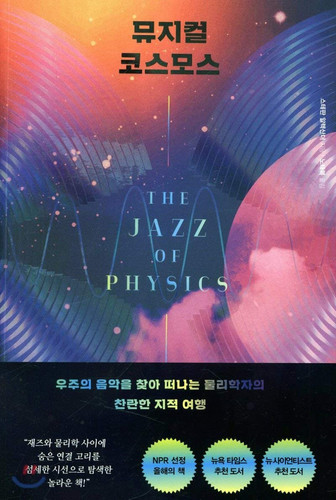
뮤지컬 코스모스
7 views
Get This Book
Prices may vary. Links may earn us a commission and open external websites.
Publisher
부키
ISBN
ISBN-13: 9788960516724 ISBN-10: 8960516724Synopsis
Musical cosmos
b The physics professor and jazz musicians autobiographical story to find the hidden link between space and music
NPRs Book of the Year
[New York Times], [New Scientist] b
Physicist and jazz musician, the author attempts to explore the music of the universe or the musical cosmos from ancient times. He followed the footsteps of the great figures who saw the connection between music and the Pythagoras, Kepler, Newton, Einstein, etc. to find a universal connection between music and physics. In the process, we can see how the old people, such as Pythagoras, understood the sound, and how their ideas and practices resulted from the efforts of great thinkers such as Kepler and Newton, resulting in a current knowledge of the dynamics of strings and waves.
This cosmological journey is accompanied by the authors own story. Throughout his life, he tried to find “isomorphism” between jazz and cosmology, from his childhood music lessons at the Bronx, New York, to his study of theoretical physics at Imperial College, Londons sacred site. Blowing a saxophone, calculating equations, and improvising, the author uncovered the fundamental waves and their associations that make up sound. By connecting the two fields of physics and music with the concept of "ubiquitous," we can understand physics through sound.
b The physics professor and jazz musicians autobiographical story to find the hidden link between space and music
NPRs Book of the Year
[New York Times], [New Scientist] b
Physicist and jazz musician, the author attempts to explore the music of the universe or the musical cosmos from ancient times. He followed the footsteps of the great figures who saw the connection between music and the Pythagoras, Kepler, Newton, Einstein, etc. to find a universal connection between music and physics. In the process, we can see how the old people, such as Pythagoras, understood the sound, and how their ideas and practices resulted from the efforts of great thinkers such as Kepler and Newton, resulting in a current knowledge of the dynamics of strings and waves.
This cosmological journey is accompanied by the authors own story. Throughout his life, he tried to find “isomorphism” between jazz and cosmology, from his childhood music lessons at the Bronx, New York, to his study of theoretical physics at Imperial College, Londons sacred site. Blowing a saxophone, calculating equations, and improvising, the author uncovered the fundamental waves and their associations that make up sound. By connecting the two fields of physics and music with the concept of "ubiquitous," we can understand physics through sound.